BS 5266-1:2025 is the current British Standard providing guidance on emergency lighting in premises.
Published in October 2025, it replaced BS 5266-1:2016 and provides recommendations for the design, installation and application of emergency lighting systems when the normal lighting supply fails.
The new edition represents a full revision of the previous standard rather than simply an amendment.
What is BS 5266-1?
BS 5266-1 is a code of practice for emergency lighting in premises.
It is used by emergency lighting designers, electrical contractors, fire safety professionals, building managers and other people responsible for ensuring that suitable emergency lighting is provided.
Emergency lighting is not simply about illuminating the route to an exit.
A properly designed system may need to:
- Allow occupants to find and follow escape routes
- Illuminate emergency exits and safety signs
- Make fire alarm call points and firefighting equipment visible
- Allow hazardous processes to be made safe
- Provide sufficient lighting for people who are permitted to remain in a building
- In some circumstances, allow normal activities to continue following a failure of the normal lighting
This wider view of emergency lighting is particularly important in the 2025 edition.
What Did BS 5266-1:2025 Replace?
BS 5266-1:2025 replaced BS 5266-1:2016, which was withdrawn when the new edition was published on 29 October 2025.
The 2016 edition had been the principal UK code of practice for emergency lighting for almost a decade.
The fundamental purpose of emergency lighting has not changed, but the new standard reflects changes in related standards, technology and the way modern buildings are used.
What Are the Main Changes in BS 5266-1:2025?
1. Emergency Local Area Lighting Has Been Brought Into the Scope
Probably the most significant change is the introduction of emergency local area lighting as a clearly defined part of emergency lighting.
Traditional emergency escape lighting assumes that when the normal lighting fails, people need to leave the building.
That is not always what happens.
In some premises, occupants may be allowed to remain temporarily following a lighting failure.
Emergency local area lighting provides sufficient illumination for people to remain and move safely within those areas where the risk assessment permits this.
This means the emergency lighting strategy needs to consider more than simply:
“Can everyone find the fire exit?”
It also needs to consider what happens if people are going to remain in the building.
2. Standby Lighting Is Now Explicitly Covered
The scope has also been expanded to include standby lighting.
Standby lighting is different from emergency escape lighting.
Its purpose is to provide sufficient lighting for normal activities to continue when the normal mains lighting supply has failed.
For example, a building may have an alternative supply or generator capable of restoring lighting sufficiently for the premises to continue operating.
Where standby lighting is also being relied upon for emergency escape or local area lighting, the appropriate emergency lighting requirements still need to be satisfied.
3. Greater Emphasis on the Actual Emergency Lighting Strategy
The changes reinforce an important principle:
A lighting failure does not automatically mean that every building operates in exactly the same way.
The appropriate solution depends on the premises, the occupants, the risks present and what is expected to happen when the normal lighting fails.
Depending on the building, the strategy might involve:
- Immediate evacuation
- Occupants remaining temporarily within particular areas
- Moving occupants to another low-risk location
- Continuing normal operations using standby lighting
Emergency lighting should therefore follow the building’s risk assessment and evacuation strategy rather than simply being treated as a collection of battery-backed luminaires.
Emergency Escape Lighting Still Remains Fundamental
The familiar requirements for emergency escape lighting have not disappeared.
Emergency escape lighting continues to provide illumination so that occupants can safely leave the building and identify important safety features.
This includes lighting for:
- Escape routes
- Emergency exits
- Changes of direction
- Changes of level
- Stairways
- Fire alarm call points
- Firefighting equipment
- Safety signs
- Open areas
- High-risk task areas where applicable
The 2025 edition broadens the overall emergency lighting approach rather than replacing the principles of escape lighting.
The Standard Has Been Updated to Work With Newer European Standards
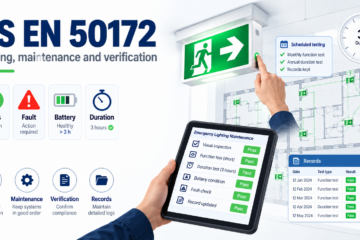
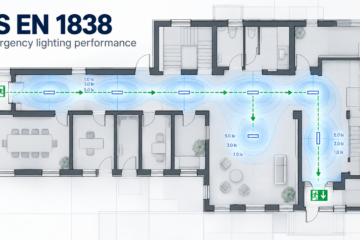
BS 5266-1:2025 also reflects revisions to the standards that sit alongside it, particularly BS EN 1838 and BS EN 50172.
BS EN 1838 deals principally with the lighting performance required from emergency lighting systems, while BS EN 50172 deals with emergency escape lighting systems and their application.
BS 5266-1 provides the UK code of practice explaining how these principles should be applied to premises.
This is one reason it is important not to treat BS 5266-1 in isolation.
Borrowed Light Should Not Be Relied Upon
The new standard explicitly makes the point that borrowed light is not included as emergency lighting because it cannot be relied upon.
Light reaching a room or escape route from another area, an adjacent building or another uncontrolled source might be present during normal conditions, but there is no guarantee that it will be available when the normal lighting supply fails.
Emergency lighting needs to be dependable when it is required.
Does the New Standard Mean Existing Emergency Lighting Must Immediately Be Replaced?
Not necessarily.
The publication of a revised British Standard does not automatically mean every existing emergency lighting installation suddenly becomes unsafe or has to be completely replaced.
Existing systems should be considered against the current fire risk assessment, the use of the building and the level of safety they provide.
However, the current standard should normally be considered when:
- Designing a new emergency lighting system
- Altering or extending an existing system
- Carrying out major refurbishment
- Reviewing an emergency lighting strategy
- Identifying deficiencies during inspection or risk assessment
Simply stating that an installation complied with an older edition when it was installed does not remove the need to consider whether it remains suitable for the premises today.
Has the Required Emergency Lighting Duration Changed?
The publication of BS 5266-1:2025 does not mean that every emergency lighting system now has to operate for three hours.
The required duration still depends upon factors including the type of premises, its occupants, the evacuation strategy and whether the building may need to be reoccupied before the batteries have fully recharged.
Some premises can use a 1-hour emergency lighting system, while others require a 3-hour duration.
Read our guide to 1-hour and 3-hour emergency lighting requirements in the UK for more information.
Is BS 5266-1:2025 a Legal Requirement?
BS 5266-1 is a British Standard rather than an Act of Parliament.
However, UK fire safety legislation places duties on those responsible for premises to provide suitable fire precautions, which can include emergency lighting where necessary.
Following the relevant British Standards is a recognised way of demonstrating good practice and can provide evidence that an appropriate level of safety has been considered.
The important distinction is that legislation creates the duty, while standards such as BS 5266-1 provide technical guidance on how an appropriate emergency lighting system can be achieved.
What Should Building Owners and Duty Holders Do?
For most building owners and responsible persons, the publication of the new standard does not mean rushing out to replace every emergency light.
It does mean that emergency lighting arrangements should be reviewed against the way the building is actually used.
Consider:
- What happens if the normal lighting fails?
- Is everyone expected to evacuate immediately?
- Could some occupants remain within the building?
- Are there activities that need to be safely shut down first?
- Is standby power available?
- Are escape routes, signs and safety equipment adequately illuminated?
- Is the existing emergency lighting system still appropriate for the current use of the premises?
Emergency lighting should form part of the overall fire safety and risk-management strategy of the building rather than being considered in isolation.
Summary
BS 5266-1:2025 is the current UK code of practice for emergency lighting of premises.
It replaced the 2016 edition in October 2025.
The biggest change is an expansion in scope. The standard now provides a clearer framework covering three different functions:
Emergency escape lighting – enabling occupants to evacuate safely.
Emergency local area lighting – allowing people to remain safely in defined areas following failure of the normal lighting.
Standby lighting – enabling normal activities to continue using an alternative lighting supply.
For contractors and those responsible for buildings, the important message is that emergency lighting design should start with what people need to do when the normal lighting fails, rather than simply determining where emergency luminaires should be installed.

0 Comments